Chronicles of Balinese Freedom

History & Cultural Etiquette

Deepen your appreciation for Denpasar's past as resident guide Julian Vance walks you through the struggle dioramas and the architectural timeline.

Deep Cultural Roots

The Legacy of the Stone Bell

The Bajra Sandhi Monument is a physical manifestation of Balinese pride, designed to resemble a *bajra*, the double-ended ceremonial bell wielded by Balinese Hindu priests during sacred prayers. This bell is the channel through which holy vibrations are cast, making it a fitting symbol for the unyielding spiritual fortitude of the islanders. It is this iconic priestly instrument which this sacred landmark is named after.

Inside the middle tier, the exhibition hall houses thirty-three miniature 3D dioramas that walk you clockwise through a comprehensive chronological history of Bali. You will start with scenes of prehistoric hunter-gatherers crafting crude tools, move through the glory days of the Majapahit Empire, and face the sobering, tragic realities of the colonial Puputan massacres.

For me, the most striking diorama depicts the Puputan Margarana of November 20, 1946. Led by the national hero Colonel I Gusti Ngurah Rai, Balinese freedom fighters launched a final, defiant charge against overwhelming Dutch military forces. They chose honorable death in battle over submission to foreign rule, an act of collective sacrifice that still defines the modern Balinese character.
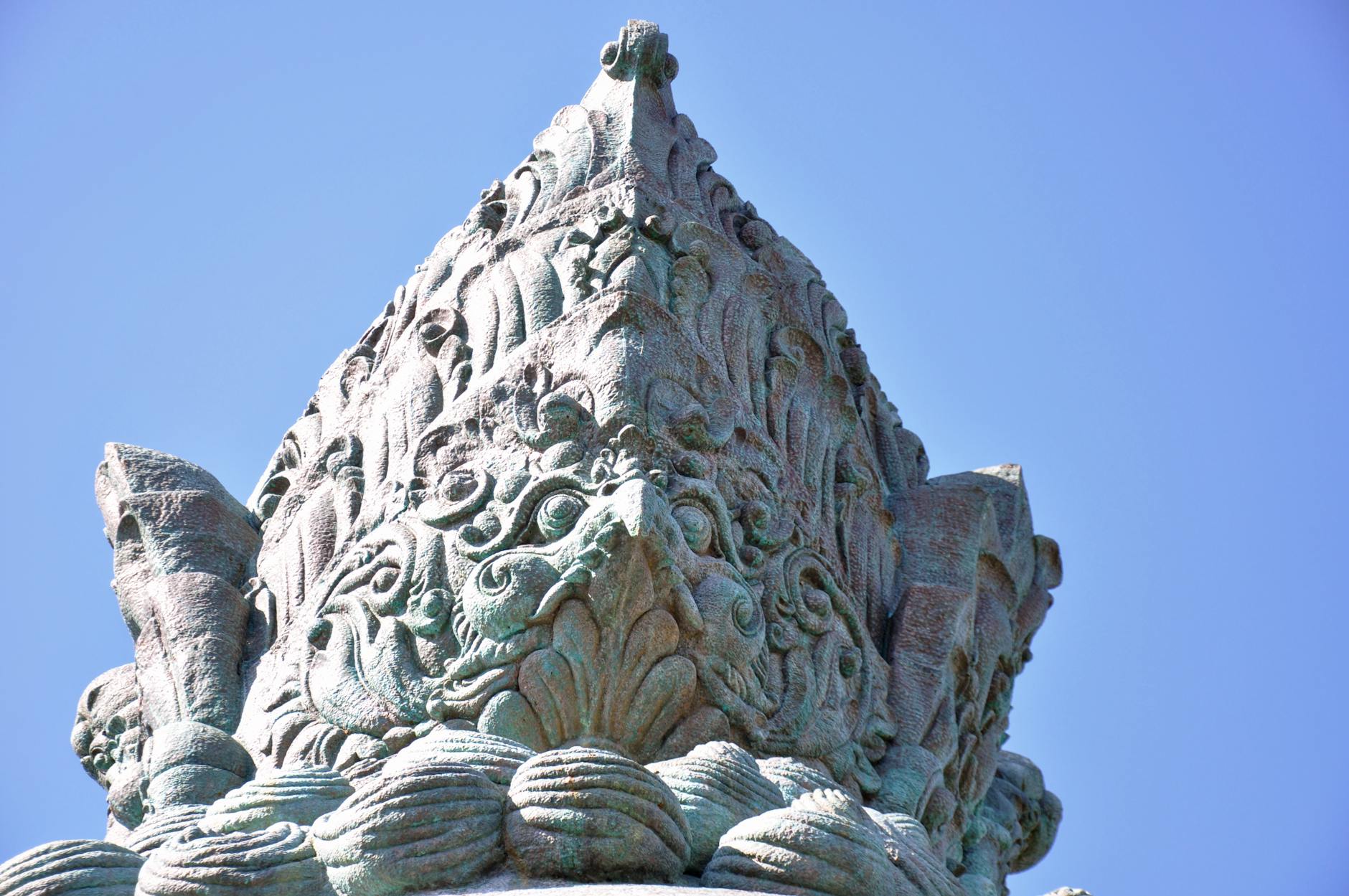
Timeline of the Monolith

A historical retrospective of how this grand stone structure went from a visionary political concept to the crown jewel of Denpasar's urban landscape.

1980

The Visionary Concept

The Governor of Bali, Prof. Ida Bagus Mantra, officially proposes the creation of a major monument to honor the historical struggles of the Balinese people, establishing a permanent legacy for future generations.

1981

Blueprint & Design Selection

A competitive architectural contest yields the master design by the talented local architect Ir. Ida Bagus Gede Yadnya. His proposal beautifully blends Balinese Hindu philosophy with structural representation of Indonesia's independence date.

1987

Construction Launch

The ground is broken and construction begins in Niti Mandala Renon square. The building phase proceeds slowly and meticulously, ensuring that the stone carvings and structural integrity conform to traditional Balinese building codes.

2003

Grand Inauguration

On June 14, 2003, the completed monument is officially opened to the public by Megawati Sukarnoputri, the President of Indonesia. It instantly becomes a central hub for civic life and cultural tourism in Denpasar.

Visitor Etiquette & FAQs

Read these essential tips before arriving at the monument grounds to ensure a smooth, respectful, and highly rewarding cultural experience.

What does Bajra Sandhi symbolize?

The monument stands as a magnificent tribute to the historical resilience and independence struggles of the Balinese people against foreign colonization. Structurally, it is rich in symbolic values: the shape resembles the *Bajra* (the sacred ceremonial bell wielded by Hindu priests), and the architecture incorporates independence numbers (17 gates, 8 major pillars, and a height of exactly 45 meters, honoring August 17, 1945).

Who built the Bajra Sandhi Monument?

The visionary concept was initiated in 1980 by the then-Governor of Bali, Prof. Ida Bagus Mantra. The physical blueprints were crafted by the renowned local Balinese architect Ir. Ida Bagus Gede Yadnya. Construction began in 1981, and the monument was officially inaugurated on June 14, 2003, by then-President Megawati Sukarnoputri.

How tall is the Bajra Sandhi Monument?

It rises to a height of exactly 45 meters from its base. This height is a deliberate tribute representing 1945, the year of Indonesia's proclamation of independence from Dutch colonial rule.

Is Bajra Sandhi accessible to all visitors?

The surrounding Renon public gardens, outer paths, and ground floor history museum are highly accessible for all visitors. However, the top-level panoramic tower (*Utamaning Mandala*) is accessed exclusively via a narrow, steep spiral staircase wrapped around the central pillar. Visitors with severe physical constraints or cardiorespiratory issues should avoid making this steep climb.

Who should avoid bajra?

If you are looking up dietary guidelines on Google, you will find warnings advising people with thyroid issues, iodine deficiencies, or kidney stones to avoid eating 'bajra' (which means pearl millet grain in Hindi). But at our Bajra Sandhi Monument in Bali, 'Bajra' represents a priestly stone bell—so the only people who should avoid our Bajra are those who suffer from vertigo or severe claustrophobia while climbing steep, narrow stairwells!

What are the 8 types of sandhi?

In Sanskrit grammar and Ayurvedic anatomy, there are complex references to eight types of 'Sandhi' (representing phonetic word junctions or joint movements in the body). However, in the context of our monument, 'Sandhi' simply translates to sacred connection or union. You do not need to memorize grammar rules to appreciate the majestic union of stone, spirit, and historic memory preserved here.

What is the appropriate dress code for the monument?

Although the monument is a secular museum rather than an active Hindu temple, it is treated as a highly sacred memorial site. I strongly advise visitors to wear modest clothing that fully covers their shoulders and knees. Swimwear, sheer clothing, or highly revealing outfits are inappropriate and disrespectful.

Are there food and drink options on-site?

Food and sweetened beverages are strictly prohibited inside the indoor museum halls and diorama galleries to prevent pests and preserve the exhibits. However, the surrounding Renon park is filled with excellent local food stalls, juice vendors, and modern coffee shops where you can grab a refreshing cold drink after your tour.